BLACKMORE / EXCHANGE / 2026
BIT TRADE GLOBAL EXCHANGE

Bit Trade Global: the economic market for data, technology and rights

BTG — Bit Trade Global is engineering a stock-exchange-style marketplace where eligible data assets, original algorithms, research outputs and executable inventions can be individually identified, disclosed, listed under ticker symbols, priced through bids and offers, and bought or sold through properly authorized instruments. Like a conventional stock exchange, its architecture includes issuers, instrument information, order books, holdings, transaction histories and immutable ledger evidence. A data-use licence, an assignment of actual rights and an investment security are legally different classes; each must meet its own requirements before live trading.

PUBLIC ADOPTION SITE · NOT A LIVE TRADING VENUE

THE DATA STOCK EXCHANGE

How Bit Trade Global is designed to trade data assets

01 / Assets become listings

A qualifying dataset, algorithm, intellectual-property asset or working invention receives a distinct asset record. An issuer establishes its actual authority, creates an information sheet and—where eligible—lists a defined instrument under a ticker symbol.

02 / Bids, offers and market prices

The Exchange architecture supports order books with buy orders, sell orders, price/quantity limits, transaction history and holdings. Market value is intended to be discovered through genuine participant demand—not automatically assigned by a hash, algorithm or issuer claim.

03 / Different instruments, different rules

Commercial-use rights, transferable IP/revenue rights and investment securities are separate products. A data licence does not make the buyer an investor; a proposed investment needs lawful issuance, disclosure, suitability and any required market authority.

Exchange software and sandbox matching exist in engineering; this page does not represent live regulated trading, settled investor funds or an available securities exchange. Read the instrument, listing and market framework →

ASSET-FIRST CAPITAL FORMATION · I-CLASS INVESTMENT

The investment is in the asset's future—not just a licence to use it

01 / THE UNDERLYING DATA

A specific dataset, algorithm, DataChip or Genome is identified, independently assessed and linked to legally verified rights. BTG's documented flagship example is DCO-000001, a robotics failure-and-recovery dataset.

02 / THE SHARE OFFERING

A dedicated legal issuer could be formed to commercialize that asset. Subject to actual approval, it could issue participating shares, or a separate properly classified financial instrument. The holder owns issuer securities, not a slice of the raw data.

03 / STOCK-MARKET TRADING

Eligible investment securities could have a distinct ticker, issued unit supply, investor disclosures, buy/sell order book, holdings and market-derived share price. The issuer's business prospects—not merely licence receipts—can inform investor demand.

The engineering stages investment-security proposals as SHARE, DEBT, FUND_INTEREST or OTHER_REGULATED_SECURITY, but does not yet create real securities, settled balances or live regulated trades. Primary issuance and secondary market authority are separate requirements. Read investment instrument terms and disclosures →

COMMERCIAL AND FINANCIAL RIGHTS

Two markets, with separate legal authority

Commercial rights come before financial instruments

BTG proposes a marketplace for defined licences to data, analysis, software capabilities and research outputs. An eligible buyer acquires only the usage rights stated in the licence: purpose, duration, territory, transfer rights and exclusions. An investment security is different: it must be created by a lawful issuer under corporate and applicable securities law. A licence holder does not become a shareholder, and asset ownership is not established by issuing a ticker.

Issuer admission requires a defensible information record

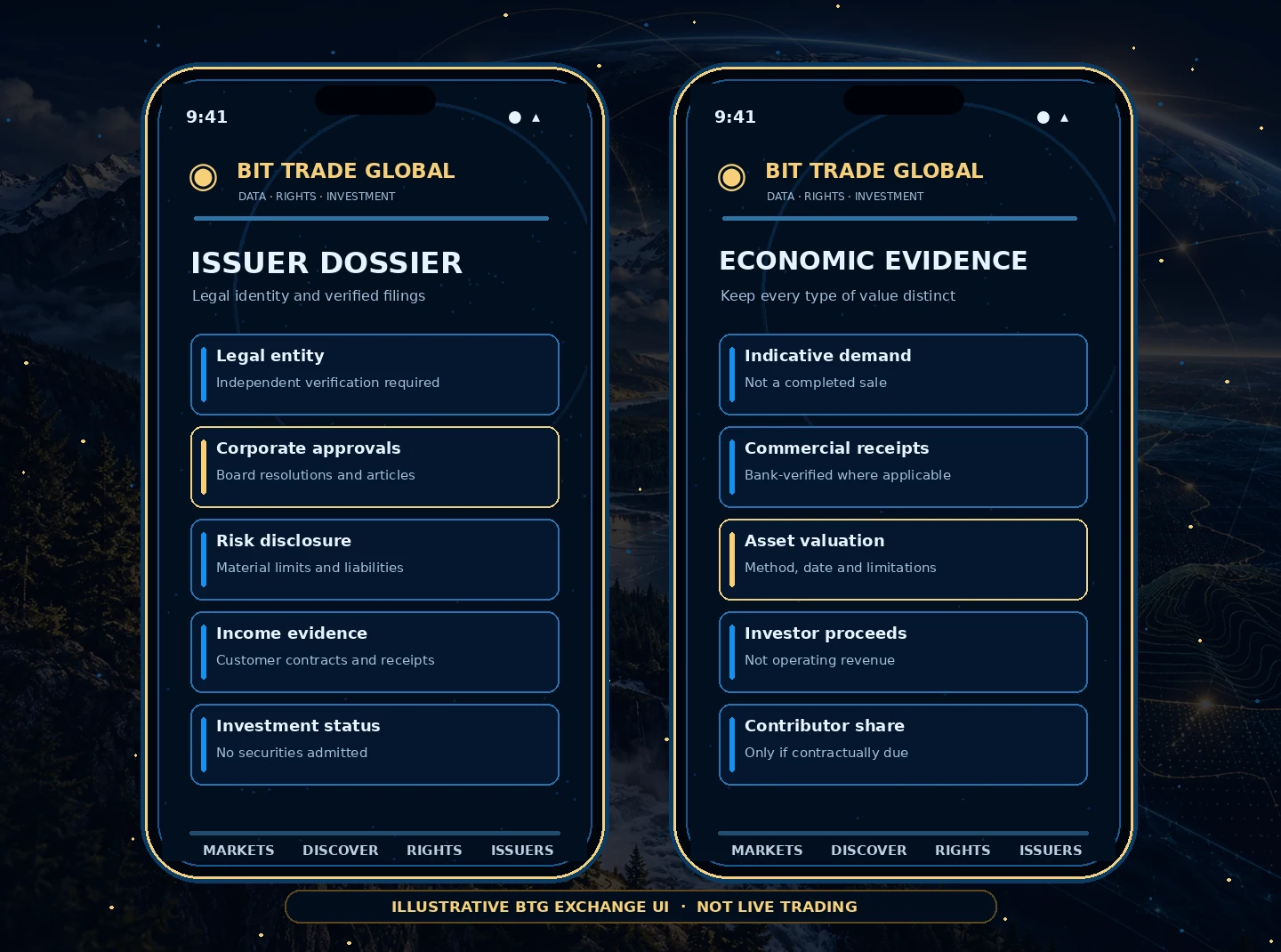
An issuer information sheet should identify the organization, its legal capacity, associated assets, available rights, restrictions, revenue evidence, material risks, governance, and dated filings. Records need a clear verification status. Unverified assertions are labelled as such; financial values cannot be silently populated from demonstrations or internal forecasts.

A launch sequence is not a licence to operate a stock exchange

An appropriately structured primary securities offering, if one is pursued, has its own prospectus-exemption, purchaser-eligibility and intermediary questions. Multilateral secondary securities trading needs separate regulated-market authorization. Until such requirements are satisfied, price charts, order books and settlement illustrations are demonstrative designs rather than executable investor transactions.

BIT TRADE GLOBAL · APPLICATION PRESENTATION

See the proposed Exchange experience.

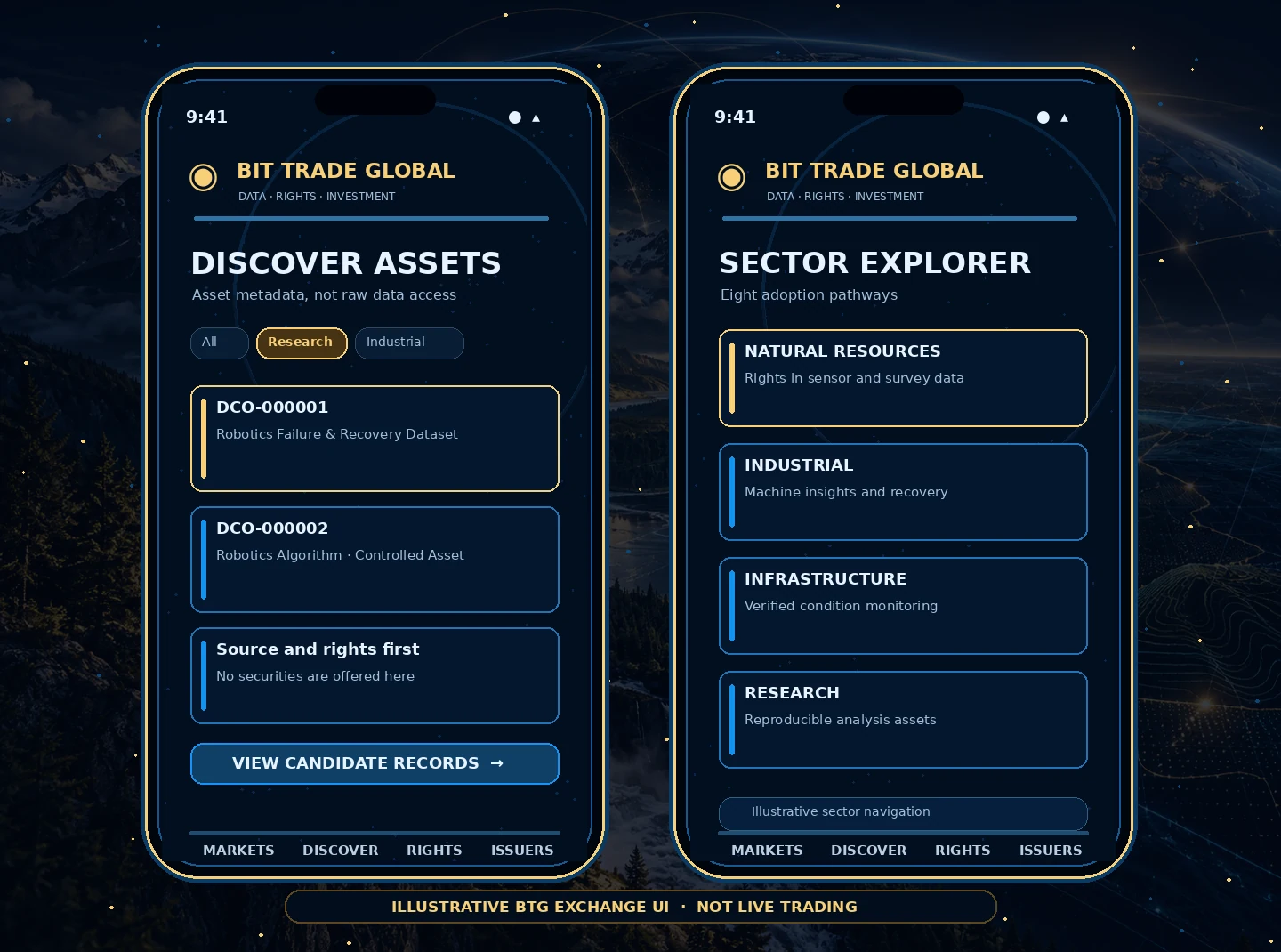
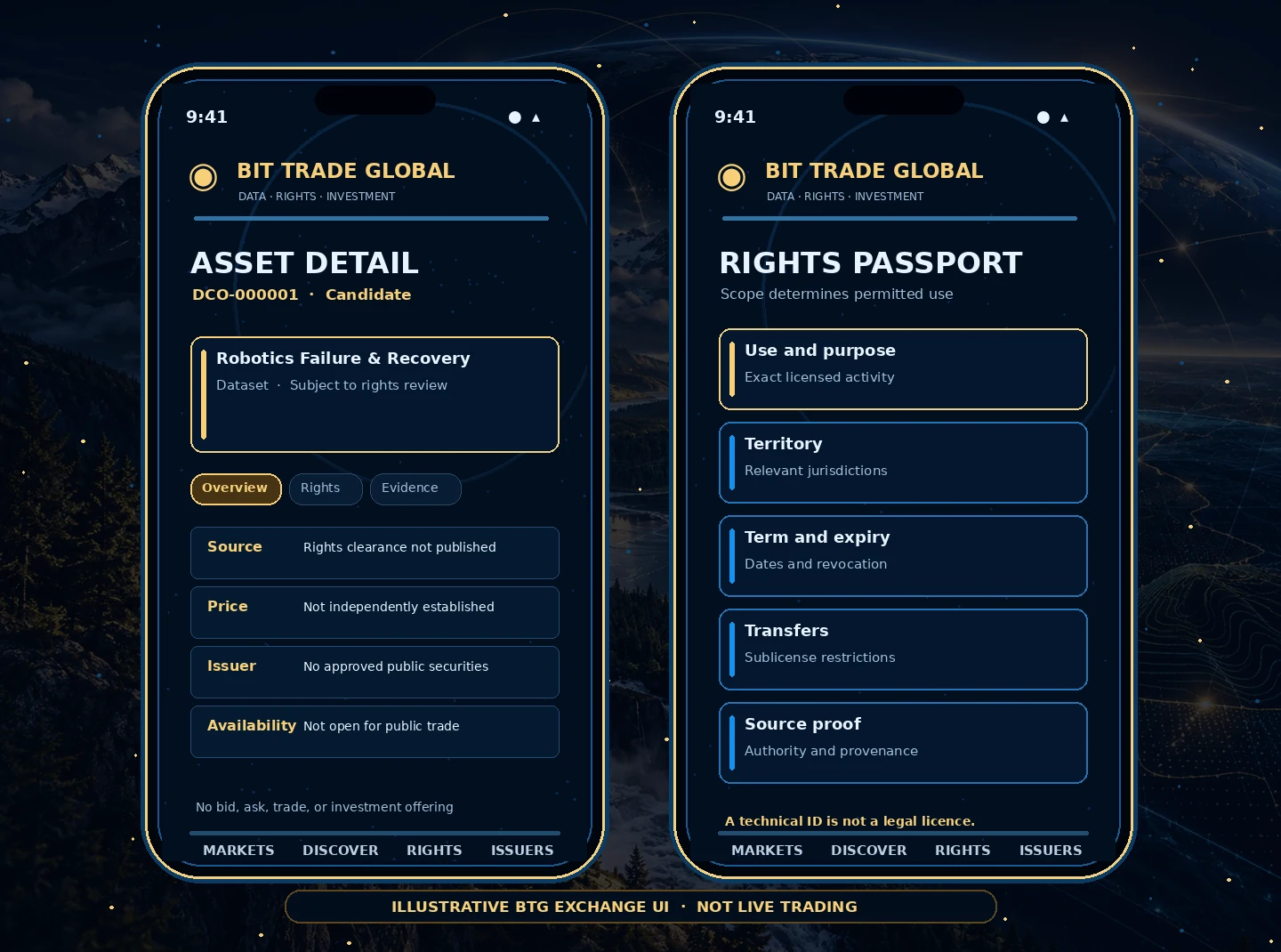
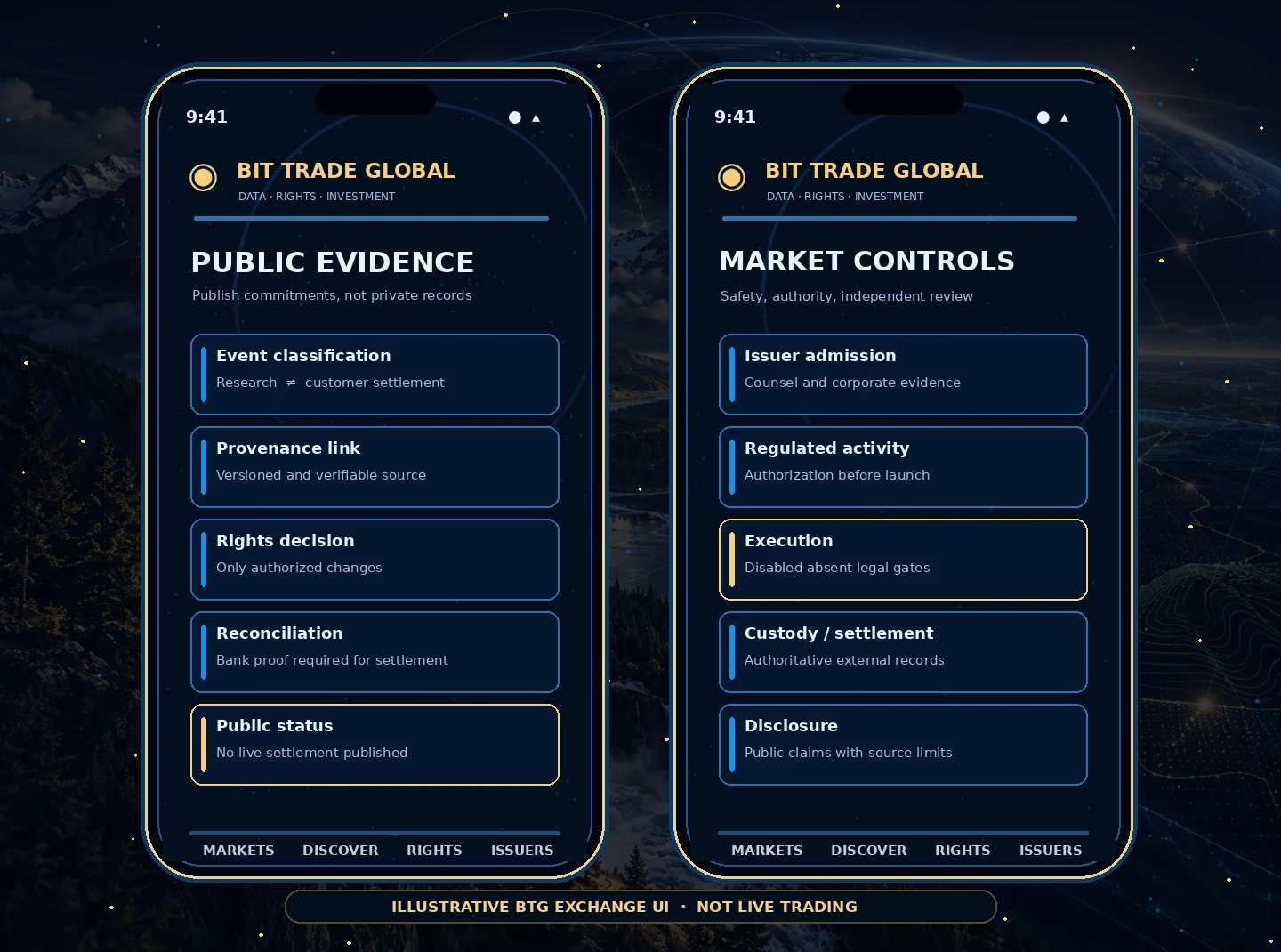
Four coordinated interface presentations show how a visitor would move from discovery to a candidate asset, review rights, inspect an issuer and check publication evidence. These representative application screens illustrate the proposed experience; they are not live market quotations, confirmed transactions or executed settlement records.

All app screens are illustrative, not operational screenshots or evidence of an authorized market. The original approved Exchange design remains part of the website.

BIT TRADE GLOBAL EXCHANGE

Section 01 / 05

Two marketplaces with different legal foundations

The first activity is commercial access: an authorized business can licence the execution of an algorithm, a bounded dataset query, a defined analysis, a Circuit or a recoverable software capability. These are contractual permissions, potentially non-exclusive, with explicit limits on purpose, duration, geography, users, throughput, source access, onward transfer, modification and sublicensing. Delivery can occur through remote execution so that sensitive source data never has to be downloaded by the customer.

The second activity concerns financial interests. A business that controls the appropriate commercialization rights may seek capital through an eligible primary offering or other lawful financing. Its investors would own the rights stated in that security or contract, not the underlying raw data by implication. A secondary trading system and a regulated exchange are not the same as a technical order book; their operators, dealers, custody, investor eligibility and disclosures require separate authorization.


Section 02 / 05

What an asset listing should actually reveal

An asset profile needs a useful public description, versioned identity, source family, rights holder and originating work, available qualification evidence, dependencies and supported operating conditions. It must state what cannot be disclosed: private customer files, trade secrets, third-party source material or an Indigenous community’s controlled knowledge. The public catalogue should make a right understandable without treating discoverability as consent to inspect the raw payload.

The Rights Passport is attached to a specifically described offer, not just a vague ticker. A buyer should see permitted activities, restrictions, expiry, quantity or call limits, governing agreement, delivery route, withdrawal or revocation rules and whether any downstream rights survive termination. A record can be a candidate under review while issuer documentation, title or outside evidence is incomplete; its status must say exactly that.

Section 03 / 05

Price discovery is not a substitute for value evidence

An asset may have replacement cost, independently demonstrated operational savings, actual licensing revenue, comparable contract terms or observed third-party offers. Each measure answers a different question. A seller’s estimate, an AI model’s prediction and a settled commercial price are not equivalent, and none of them automatically gives a share price to the company associated with the asset.

For an asset-backed business case, an issuer would also disclose operating costs, dependencies, contracts, ownership disputes, demand concentration, dilution, control, liabilities and factors affecting revenue. The source whitepaper describes a proposed 2.9% plus C$0.30 transaction fee, but it expressly warns that payment-processing costs can consume much of the apparent gross fee. That is a pricing proposal, not reported revenue or a demonstrated operating margin.

Section 04 / 05

What happens before a customer receives anything

An eligible customer identifies a specific offer and jurisdiction. The service verifies identity where required, applicable licence authority, payment terms, current asset version and restrictions. An accepted contract is not the same event as a settled payment. Approved fiat payment rails confirm actual funds; the relevant delivery system then issues the approved entitlement or executes the service. The transaction fabric connects the legal, technical and financial receipts without exposing confidential fields in the public record.

Where contributors are entitled to a share under real agreements, the entitlement calculation references the settled receipt, applicable deductions, taxes, refunds and reserves. Repeated technical use does not create automatic duplicate royalties. An audit view may disclose privacy-preserving event commitments, but a ledger token is evidence of an event, not a speculative settlement coin or a security.

Section 05 / 05

Admission standards and unresolved market status

An exchange-quality information sheet needs issuer identity, actual legal title, complete economic terms, risk factors, continuing disclosure obligations, provenance evidence, material updates and an admission decision by the authorized operator. No ticker, price chart, order book depth or subscription button should imply that issuance has happened merely because a working concept or internal asset exists.

The public website is explaining the architecture and candidate asset records. It is not collecting investment subscriptions, listing approved securities or representing Bit Trade Global as an authorized stock exchange. Commercial launch, market operation and regulation are independent milestones that must be supported with written evidence and published when they are true.

What the records must establish

Facts that belong in the supporting evidence

Commercial licenceDefined use of asset/service; no implied asset ownership
Assignment or entitlementSpecifically documented transfer or contractual proceeds
InvestmentInterest issued by a qualifying legal issuer under applicable law
SettlementExternally verified funds, not a signed message alone
Market dataActual authorized offers, transactions and valuations with timestamps and methods