
THE UNDERLYING ASSET
A specific dataset or invention may be the main economic driver. It has its own technical ID, quality evidence, rights provenance and valuation assumptions.
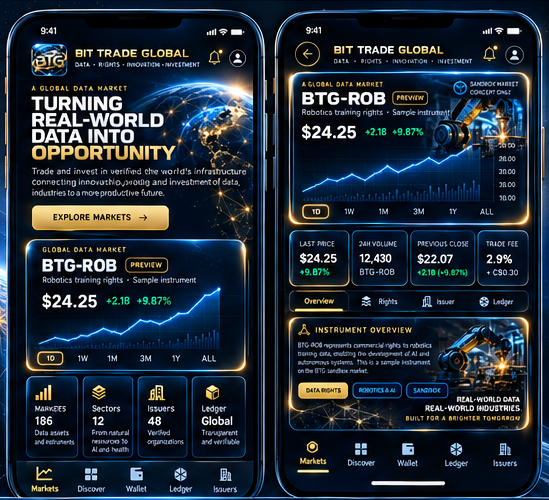
Bit Trade Global is designed to support stock-market-style listings for qualifying data assets and intellectual property. Each ticker must identify a precise legal instrument, underlying asset, issuer, disclosures and risks. U covers contractual usage; A covers genuinely transferable IP or defined economic rights; I covers lawfully issued investment securities tied to potential asset value. All three are different from automatically owning a dataset or shares in its creator. Market mechanics are engineered; live regulated offers are not implied.


 ONE ASSET FAMILY CAN SUPPORT DIFFERENT RIGHTS STRUCTURESBIT TRADE GLOBAL
THE I CLASS · ASSET-FOCUSED EQUITY AND OTHER SECURITIES
A specific dataset or invention may be the main economic driver. It has its own technical ID, quality evidence, rights provenance and valuation assumptions.
A dedicated issuer may offer ordinary participating shares; engineering also contemplates debt, fund interests and other regulated securities. Shareholders own securities of the issuer, with voting, dividend and resale terms governed by actual legal documents—not direct ownership of the raw dataset.
An issued class can have a separate investment ticker, disclosure, unit supply, order book, trade price and statutory holder record where legally authorized. The wallet is only a mirror of real legal rights.
For DCO-000001, the legal dossier uses 100,000 shares at C$1 as an illustrative capitalization example. No price, issuance, shareholder rights or public securities market is effective until legally constituted, funded, registered and authorized. Read investment instrument terms and disclosures →
A knowledge asset can support separately defined commercial or financial instruments, but buying one class never automatically grants the rights of another. These symbols identify the proposed class, not securities already issued.
A defined licence for approved use of an eligible dataset, capability or algorithm. Scope, duration, delivery, geographic rights and downstream restrictions are contractual.
A documented assignment, IP interest or enforceable revenue entitlement. The precise underlying agreement, origin of rights and any restrictions control what a holder actually receives.
An issuer-created legal financial claim, requiring genuine issuance authority, proper investor disclosures and applicable securities permissions. A proposed ticker or illustration is not an issued security.
Status: Class names and these symbols describe a proposed rights taxonomy. They do not certify ownership, indicate live trading, or replace underlying contracts, registries and regulatory authorizations.
U, A AND I INSTRUMENT CLASSES
A U-class proposal is concerned with what a purchaser may use, not who owns the entire original dataset or a company. Its public information must define permitted purposes, licence term, data delivery or secure-access conditions, territory, expiration, downstream disclosure and remedies for misuse. Pricing would be for precisely that defined unit and cannot be inferred from a general asset valuation.
An assignment or royalty-linked contract requires its own source-of-title, assignment authority, transfer restrictions, accounting basis and precise scope. A percentage of commercial receipts cannot be presumed to exist without an enforceable agreement. The Rights Passport must expose both granted rights and third-party encumbrances so subsequent buyers understand what is excluded.
An I-class instrument can exist only when an actual legal issuer creates securities with documented governance and economic terms. Its prospectus or exemption route, investor eligibility, issuance, resale limits, official register, risk disclosure, proceeds and any lawful distributions must be established separately from the technical asset. A candidate listing, token identifier or internal reference price is not a securities offering.
INSTRUMENT RIGHTS
A U-class example is a manufacturer paying to execute a fault-detection algorithm for a fixed period and operating environment. The document must specify the executable version, supported inputs, permitted users, transaction or throughput limits, maintenance, service availability, expiry and prohibited activities. It should say whether the buyer can retain outputs, modify code, train other models, reverse engineer the method or subcontract the calculation.
A valid use licence can be non-exclusive. Other customers may receive independent permissions under separate agreements. Therefore a count of granted licences must not be described as a fixed pool of scarce company shares; utility and contractual pricing depend on the offer’s actual scope.
An A-class record must state the precise thing changing hands. An outright assignment of some intellectual-property rights is legally different from an exclusive field-of-use licence, a limited sublicense or a contractual share of future licensing proceeds. The instrument has to identify the underlying agreement, contributing parties, restrictions inherited from source material, effective dates, territorial scope and conditions under which the arrangement ends.
An apparent contributor entitlement is only as reliable as the agreements and settled receipts that support it. A formula allocating ten per cent of qualifying proceeds does not create a distributable balance before a qualifying payment is received and deductions, refunds and competing claims are resolved.
An I-class record concerns a financial or investment interest issued by a legally capable entity under applicable law. It needs the actual issuer identity, governing corporate documents, instrument rights, offering exemption or authorization, eligibility conditions, risk disclosures, register or custodian, transfer restrictions and the applicable regulatory framework. A holder may have voting, dividend, repayment or other terms, but only if the legal instrument actually grants them.
Owning an eligible interest in a company whose business uses a dataset does not mean the investor owns the source records or can request copies. An internal asset ID, ticker-like code, candidate quantity or wallet balance cannot serve as proof that a share was lawfully issued.
Every profile should identify the legal issuer or owner, subject asset and version, source provenance, permissions already obtained, proposed economic instrument, claims about technical performance and the evidence behind those claims. It should disclose price methodology, original currency, valuation date, actual volume or the absence of trading, associated fees, legal restrictions, relevant jurisdictions, disputes, dependencies, concentration risk and the process for correcting errors.
The applicant’s statement and an independent assessment must be labeled differently. Claims requiring professional legal review—especially ownership, securities classification, market admission and royalties—remain pending until actual documents are produced and reviewed. Unverified fields remain clearly identified until supporting evidence is available.
The whitepaper identifies DCO-000001 as a proposed Robotics Failure & Recovery Dataset and DCO-000002 as a separate BTG-controlled robotics algorithm. One is a data subject; the other is a software method. They may be related, but permission to use one does not automatically prove ownership of the other. Neither working name establishes a live market listing, official ticker, CUSIP/ISIN, independent valuation or settled investment transaction.
The candidate sheets should therefore explain the observable subject, potential research usefulness, required rights chain, source constraints, proposed uses, maturity of evidence and missing public filings. Only after those gaps are resolved would any commercial offer or financial interest be presented as legally available.
What the records must establish
| Identity | Owner or issuer; asset version; data/software rights chain |
|---|---|
| Holding | Exact use, assignment, proceeds or financial interest |
| Disclosure | Applicable fees, limitations, governance, risks and conflicts |
| Proof | Independent technical results, signed authority and actual financial receipts |
| Status | Candidate, admitted, contracted, issued or settled—never conflated |