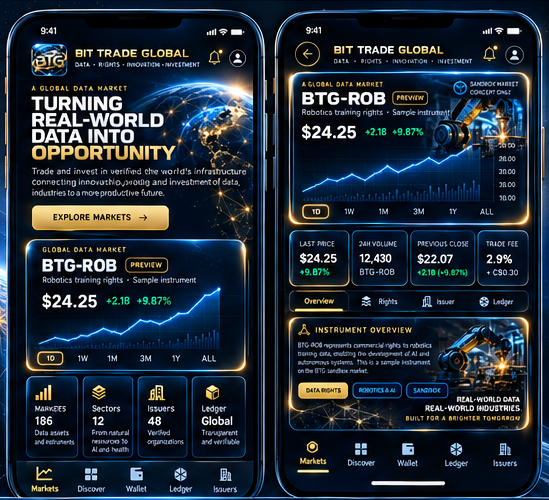
Bit Trade Global: the commercial and investment economy around knowledge
One name, two legally different markets
Bit Trade Global is the financial and commercial arm of the overall Knowledge Capital Economy. It is built around an idea that sounds simple but has major implications: the useful underlying knowledge asset should be visible as an economic subject in its own right. A company may own or control valuable rights in an invention; investors normally value the company as a whole. BTG is engineering a way to describe the particular asset, its provenance, technical usefulness, customers, restrictions, commercial income and possible contribution to an enterprise's value.
The first market is for commercial rights. A buyer might pay to run an algorithm, access a permitted dataset, receive a restricted analysis, use a qualified Circuit, or licence particular software. These transactions are governed by intellectual-property, contract, data-protection, tax and other applicable law. They are not automatically financial securities.
The second is for investment instruments. Here the buyer is an investor rather than a user of the software. An eligible legal issuer may, with the proper corporate and securities arrangements, offer shares or other defined financial interests in a business associated with an asset. Investors receive exactly the rights stated in those instruments, such as an interest in company equity or an authorized income arrangement. They do not automatically receive ownership of a dataset or permission to read confidential data.
The distinction is essential. A person who pays to run a robotics algorithm has bought permitted utility. A person who owns shares in the company commercializing that algorithm owns the corresponding legal financial interest. A contributor with a contractual share of licensing revenue holds a different entitlement again. The system records all three without inventing a single token that means everything.
How an asset becomes discoverable
Consider an algorithm used to reduce waste in industrial production. Before a commercial listing, its records can identify its version, origin, qualified use case, important dependencies, permitted rights, supported customer environments and available technical evidence. A buyer can see a non-sensitive summary without gaining access to protected source material or private training data.
The marketplace can support a Rights Passport that makes the offer understandable: what may be used; by whom; in which industry; for how long; with what quantity or operating limits; whether the buyer can modify or sublicense it; and what happens if the right expires. For a marketplace serving many organizations, such clarity is often more important than a sophisticated trading chart.
A buyer's transaction follows the agreement. A valid customer and licence are identified; the price and terms are accepted; authorized money channels settle any payment; the defined capability or access is delivered; the transaction and relevant receipts are retained; and any applicable contributor allocation can be calculated. Where licensed access is remote rather than a file download, the customer may receive a result without ever receiving the underlying private source.
What an asset valuation means
A qualified invention may have several different economic values. It can cost a certain amount to reproduce. It may be expected to earn future licence income. Buyers may make genuine offers to use it. A comparable invention may have sold under different terms. An algorithm may produce independently measured savings for a customer. If a business issues a security and that security trades lawfully, there can also be an observed market price for the security.
These are related facts, not interchangeable prices. An asset's estimated value is not automatically its company's share price, an investor's return or the accounting value that may appear on a balance sheet. Nor does a high estimate create actual cash for the inventor. A mature marketplace needs to preserve the method, assumptions, evidence and date of each valuation. The market's credibility depends on separating an independent estimate from a seller's marketing statement or an AI-generated projection.
Why asset-first financing changes company formation
The central economic inversion begins with a qualified knowledge asset rather than requiring a large company before the asset can be recognized. Imagine a new robotics recovery method has a traceable invention record, documented legal rights, independent technical evidence and customers willing to buy licences. Those facts may allow a new operating business to raise capital to improve, service and commercialize it.
An issuer might hold several assets, or the economic business case might focus on a specific invention. In either case, investors need disclosures about the actual company, its debts, managers, dilution, expenses, security rights, customers, risks and control of the underlying technology. Investors do not get automatic rights to copy the underlying data simply because it contributes to the value of the issuer.
The system is being engineered with Canadian securities requirements in mind. A lawful restricted primary offering, a secondary trading system and a recognized securities exchange are different activities with different legal obligations. Engineering an order book is not the same as obtaining permission to operate a stock exchange. Any live securities-market functionality requires the relevant legal, operator, dealer, custody and regulatory arrangements. The infrastructure can be designed in advance without representing itself as already authorized.
DCOs, tickers and the wallet
BTG uses DCO to identify and structure individual digital commercial or intellectual assets and their defined associated rights. The working portfolio includes a proposed robotics failure-and-recovery dataset (DCO-000001) and a separate BTG-controlled robotics algorithm (DCO-000002). The distinction matters: owning a dataset is not necessarily the same as owning all algorithms developed from it; rights in the source data and derived software must each be established.
An asset identifier or ticker makes something findable. It is a name or record handle, not a magical source of legal scarcity or title. Two businesses can sometimes licence the same information non-exclusively. A company share, by contrast, is a particular legal unit of an issuer with specified rights. Those concepts must remain separate.
The BTG wallet is designed to show the user's eligible assets, commercial entitlements, contracts, contributor interests and - where properly issued - financial holdings. It can help display a Rights Passport, an accepted trade receipt, a balance or an asset transfer status. It remains a view onto the authoritative legal and financial records. The legal share register and bank or settlement provider determine facts that a wallet interface alone cannot establish.
The role of money and transaction proofs
The wider economy uses fiat currency and approved settlement rails rather than requiring every participant to buy a speculative BTG coin. A signed transaction-proof token can attest that a permitted contract or event occurred. It may support public transparency through privacy-preserving commitments, including a public verification page, while leaving confidential contracts, personal identities and banking records protected. The token should never be presented as money simply because it carries a digital signature.
Why legal rights cannot be generated by software
An algorithm can be tested and reproduced. A file's bytes can be signed and compared. A public catalogue can show an issuer's statement about an invention. None of those actions automatically gives the issuer the legal right to sell it. Legal title may depend on employment, assignment, confidentiality, copyright, patents, licences, privacy and the rights of contributing organizations.
Likewise, a database entry saying someone owns 1,000 investment units is not enough to establish that the units were lawfully issued shares. The governing corporate documents, statutory or authorized registers, investor eligibility, source of funds and applicable securities regime matter. A wallet should reflect legal reality rather than attempt to replace it.
This is not a weakness in the concept; it is the architectural reason ENTITY, ADAM, Verifiable Reality and the separate financial registries exist. The system is engineered to make such boundaries explicit so autonomous software cannot create legal or financial authority merely by calling a convenient API.
Why a commercial data marketplace and a securities exchange are different
A customer paying for permission to run a DataChip normally enters a commercial agreement for utility. An investor buying shares in a company accepts different risks and obtains different legal rights. Securities are subject to particular rules about issuance, disclosure, distribution, advice, dealing, resale, custody and marketplace activity.
In Canada, the B.C. Securities Commission administers relevant provincial securities law. Federal and national frameworks, including Canadian Securities Administrators instruments and the rules of CIRO where applicable, shape the requirements for dealers and markets. An alternative trading system and a recognized stock exchange are regulated institutional activities. A consultation letter or approved private primary securities offering does not itself authorize public secondary-market trading. [5] [6]
BTG's engineering dossier therefore separates a commercial marketplace for permitted data and software uses from any live investment-market function. The investment layer can be specified, simulated and independently examined while the required legal operating arrangements are pursued through the appropriate channels. That is a more credible foundation than assuming that describing a share as a 'bit' avoids securities law.
Asset-first financing and the creation of new companies
The most ambitious economic change is that productive knowledge might more frequently become a documented starting point for company formation and investment. An identified dataset or invention with legitimate rights and credible buyer demand could support a specialized operating business. That business might finance further engineering, servicing, compliance, marketing and research through appropriate commercial or investment arrangements.
For investors, the advantage would be clearer visibility into the actual intellectual assets underpinning part of a company's business. For inventors, the advantage could be an additional route from narrow technical discovery to a financed enterprise. For society, the advantage could be more independent innovators reaching customers before their work becomes absorbed into a small number of large platforms.
A future mature institution of this kind could be economically significant, but its size must be discussed carefully. Total value of listed assets, market turnover, issuer capitalization, customer productivity gains and BTG's own revenue are five different measurements. They cannot be added into a single figure or presented as one company's worth. A widely adopted infrastructure may support enormous economic activity while capturing a relatively modest fee for operating it.